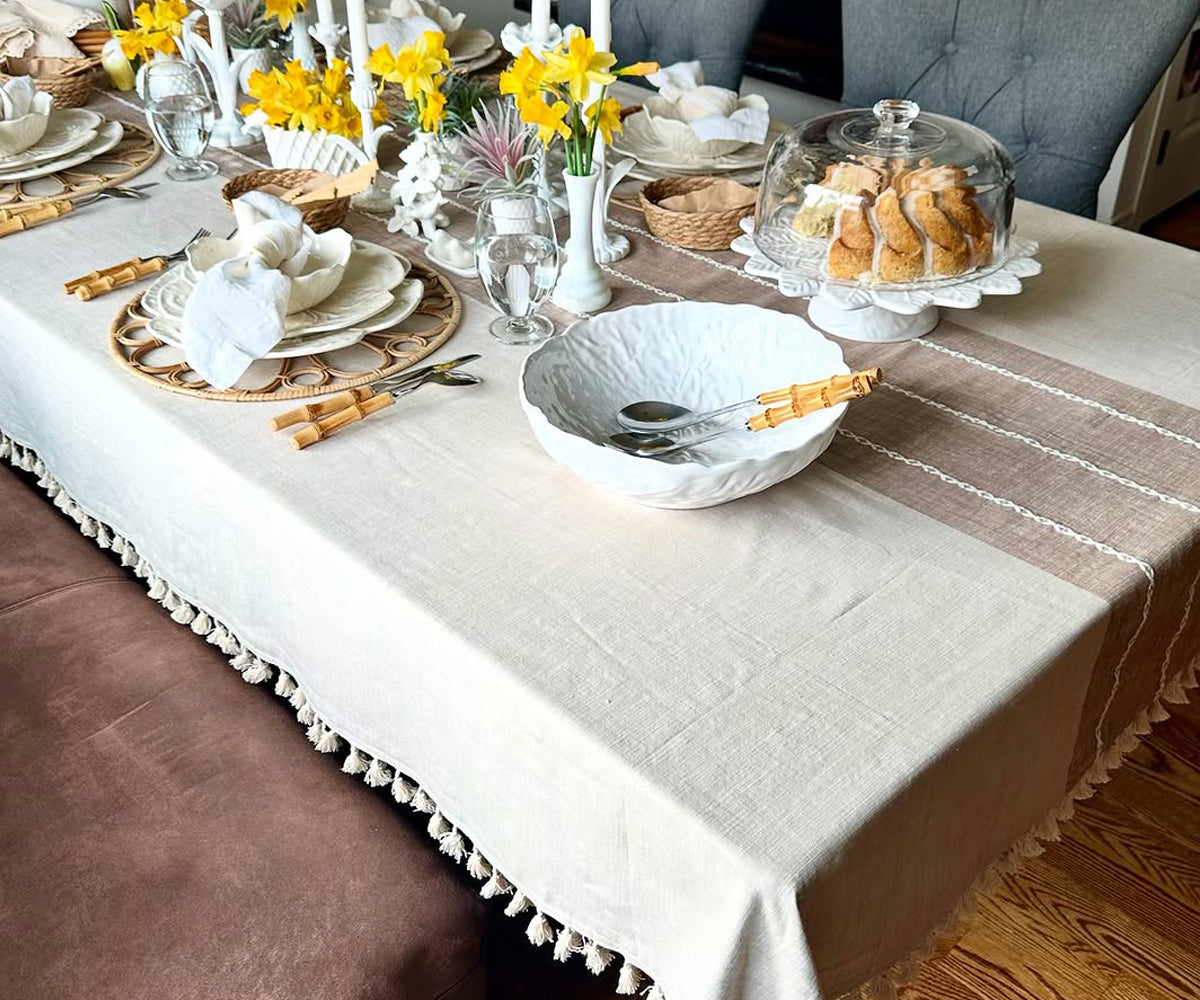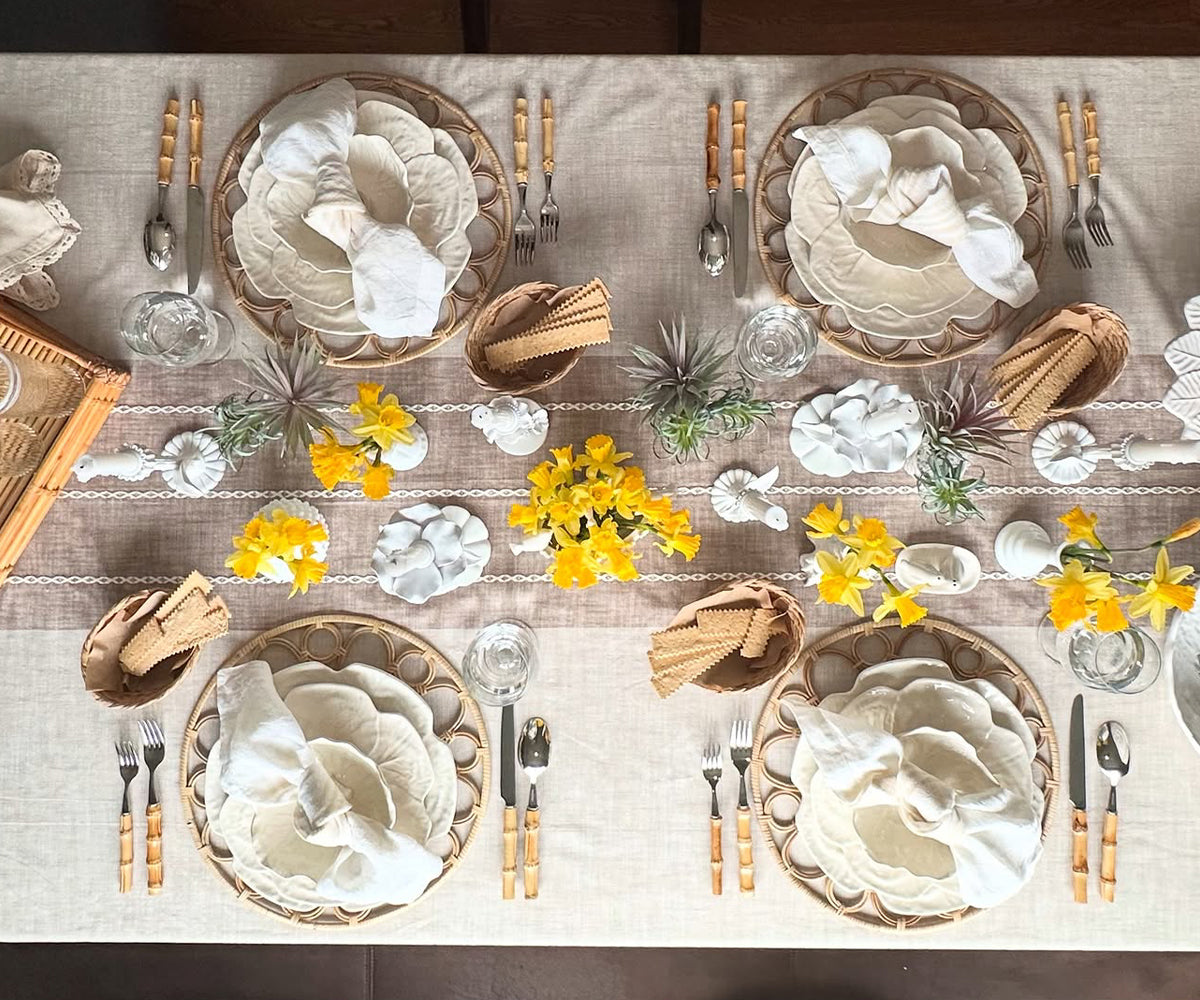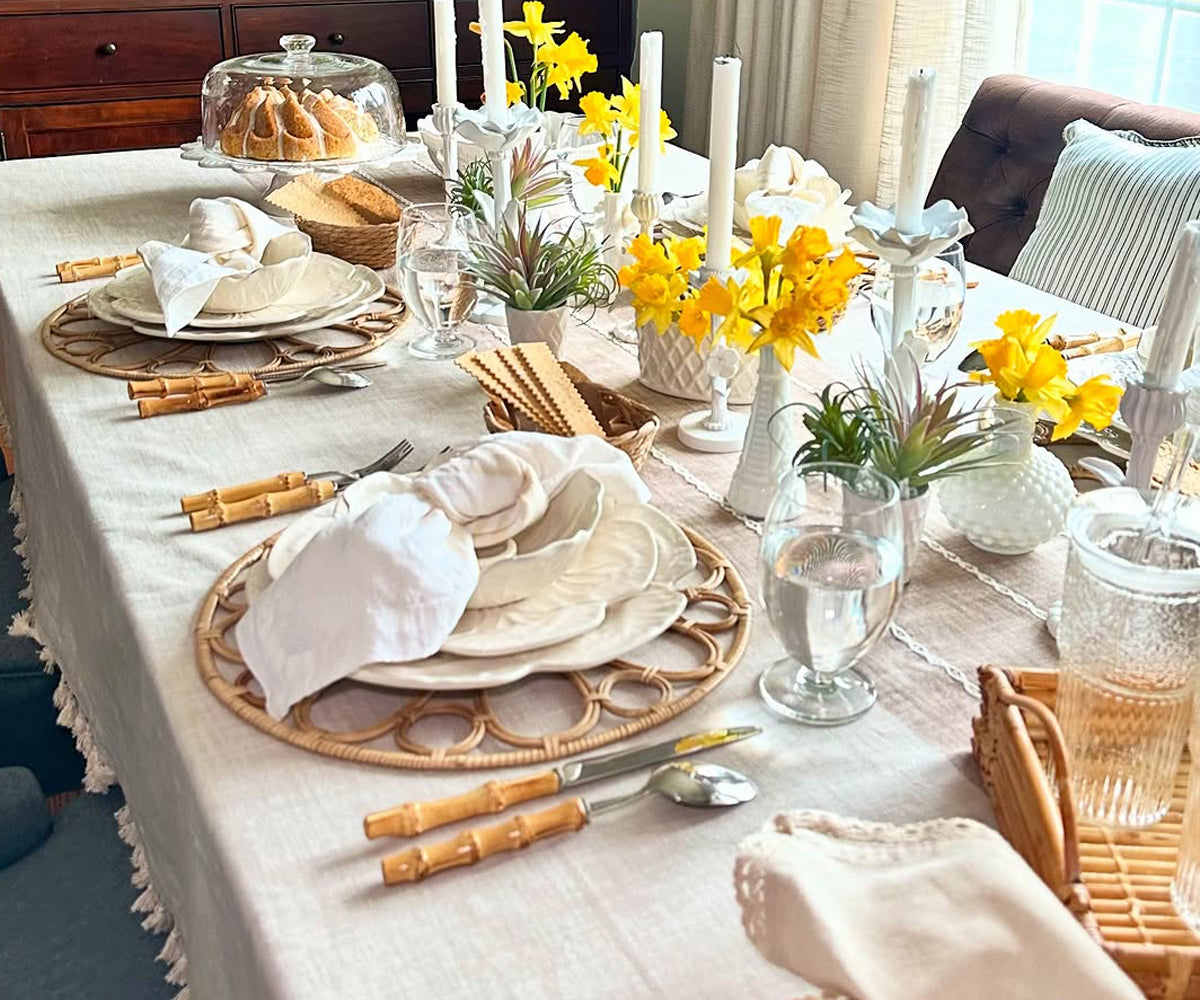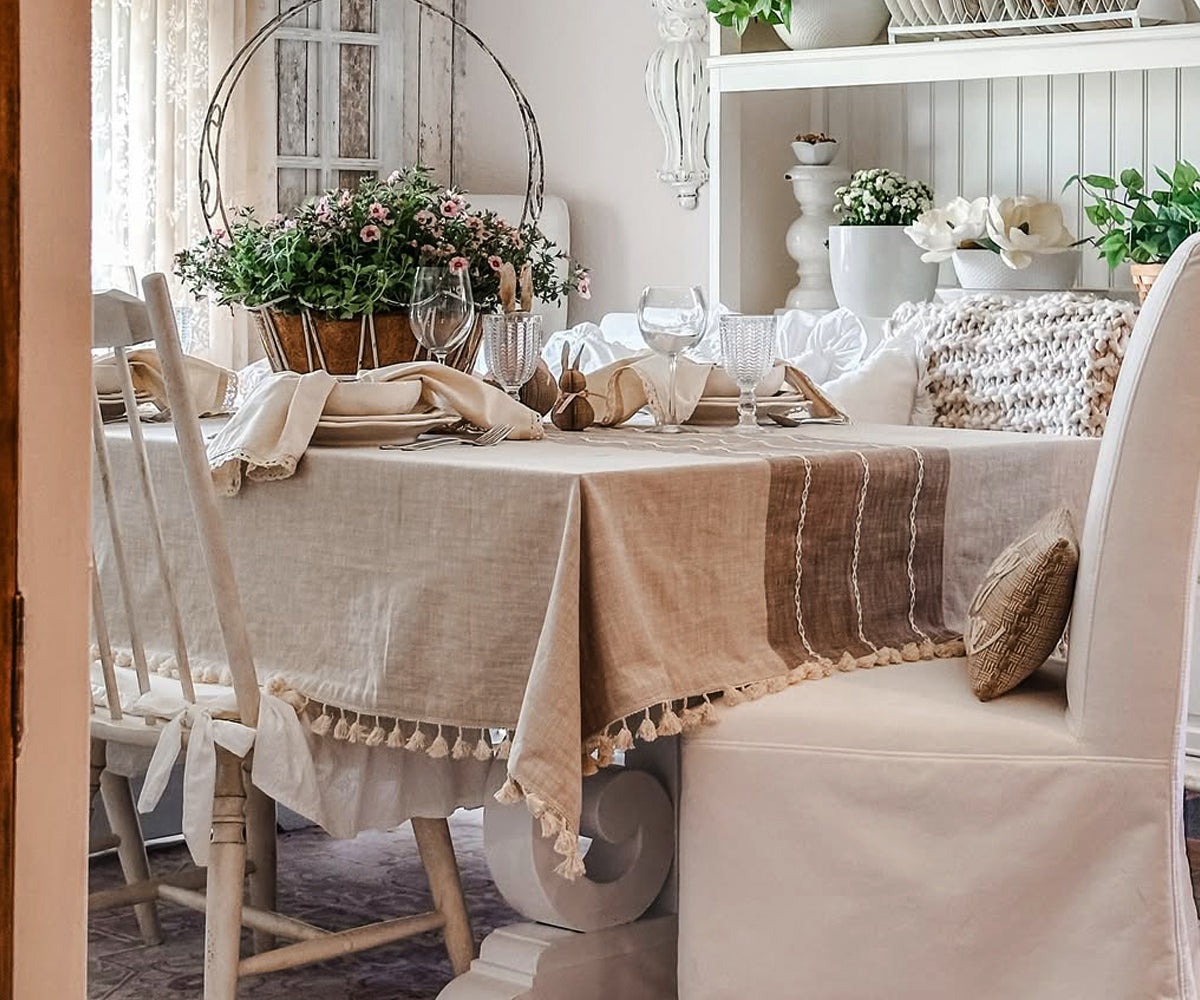

This isn't just a history lesson. Understanding where table linens come from helps you appreciate what you're buying today, why linen has endured for millennia, why certain patterns carry meaning, and why the simple act of covering a table has always been about so much more than protection.
Part One: The Ancient World - Where It All Began

Egypt: The Birthplace of Linen
The story of table linens begins with the flax plant. The earliest known household linens were made from thin yarn spun from flax fibres to create linen cloth. Ancient Egypt, Babylon, and Phoenicia all cultivated flax crops. The earliest surviving fragments of linen cloth have been found in Egyptian tombs and date to around 4000 BCE. That's over six thousand years ago.
In ancient Egypt, linen was far more than a practical textile. Egyptian priests wore linen exclusively, considering it a symbol of purity. It was so highly valued that both the living and the dead were clothed in linen. The finest linens ever made came from Ptolemaic Egypt, and the linen trade there must have been considerable from a very early period.
Linen was the fabric of the elite. It typified luxury, as captured in the phrase "purple and fine linen." While we don't have surviving records of tablecloths from this period, it's reasonable to assume that the wealthy families who prized linen for their clothing also used it to cover their dining surfaces.
Greece and Rome: The First Napkins
The Greeks and Romans inherited Egypt's linen tradition. Phoenician traders marketed Egyptian linen throughout the Mediterranean, and the Romans used it for their sails. By the Roman period, the centre of linen production had shifted to urban centres in Syria and Palestine.
But the Romans gave us something specific: the napkin. Roman guests carried their own napkins, known as mappae, to meals. They used them to wipe their hands and mouths, much as we do today. These early napkins were personal items, carried from home to dinner and back again. It was a practical solution but also a social one. The quality of your map announced your status before you even sat down.
The oldest known reference to a tablecloth dates to around 100 AD, mentioned by the ancient Latin-Spanish poet Martial. By this time, covering a dining table with fabric was already a recognised practice, at least among the wealthy.
Part Two: The Middle Ages - Status, Symbolism, and Survival
From Communal Cloths to Heirlooms
The more frequent use of dining cloths began in the Middle Ages. Medieval feasts were large, messy affairs. Long wooden tables needed protection from spills, and guests needed something to wipe their hands on. In many settings, the tablecloth served a dual purpose, not just as decoration or protection but as a communal napkin for everyone at the table.
But table linens in the Middle Ages were about far more than practicality. They became heirlooms. Table linens were frequently documented in family wills, passed down through generations as valuable assets. Wealthy households kept their linens on display in a wooden linen press, itself often elaborately decorated and positioned prominently in the home. The linen press wasn't for storage; it was a showcase of wealth.
Perugia: The First Named Tablecloth
The Umbrian region of Italy produced some of the earliest recorded tablecloths, dating back to the 15th century. Perugia tablecloths and napkins have been made since medieval times. These cloths are white with characteristic woven blue stripes and patterns, a style also associated with church linen.
This was a significant development. For the first time, tablecloths had a recognised origin, a distinctive style, and a reputation that traveled beyond their place of production. Perugian linen became a marker of quality and taste.
The Language of Whiteness
During the Middle Ages, the colour of your table linen spoke volumes. Attitudes dictated that whiter, brighter, and the most brilliant linens were symbolic of status, security, and wealth. In essence, the higher up you were socially, the whiter your tablecloths were expected to be.
White linen was difficult to produce and even harder to keep clean. It required constant laundering, careful storage, and the resources to replace it when it stained. A white tablecloth wasn't just an aesthetic choice, it was a public declaration of your household's wealth and organisation.
Damask: The Arrival of Pattern
From the fourteenth century, diaper napery with small geometric patterns was imported from the Low Countries. Towards 1450, the drawloom was adapted in Flanders to weave white linen damasks with figurative patterns. This was a technological breakthrough that would transform table linens forever.
In the early sixteenth century, damask table linen, characterised by its elaborate reversible patterns, was reserved for royalty, the church, high nobility, and the very rich among the rest of society. Patterned table linen has adorned festive dining tables ever since the Late Middle Ages.
The technique of damask weaving actually originated in Asia and reached Europe via the Silk Road. The Low Countries became a preeminent centre for its production. These exquisite textiles were often commissioned to commemorate weddings or military victories, serving as prestigious gifts or "conversation pieces" at the dinner table.
Part Three: The Renaissance and Beyond Refinement and Rules
The Rise of Formal Dining
As societies became more structured during the Renaissance, proper dining etiquette became a mark of sophistication. Table linens became more decorative, with embroidered tablecloths and beautifully folded napkins.
The 17th century saw European aristocrats follow strict rules about how to set the table. Silverware placement, napkin folding, and table settings became part of formal dining etiquette. Table linen was one of the ways households could display their wealth to visitors. The generous proportions of napkins from this period probably reflected this as much as a desire to protect clothing.
The Golden Age: 18th and 19th Centuries
By the 18th and 19th centuries, dining etiquette was an essential lesson for upper-class families. People used embroidered placemats, elegant table runners, and high-quality table linens to create luxurious dining spaces.
Table linen was part of the conspicuous outlay of the country house, designed to complement the displays of food used while entertaining friends, neighbours, and potential patrons. Armorial linen bearing family crests and coats of arms was a statement piece of conspicuous expenditure, designed to show the present wealth and taste of the owner while emphasising patrilineal heritage.
In England, fine table linen between 1450 and 1750 was a luxury commodity, with changing requirements documented in courtesy books, household books, and thousands of inventories.
Gingham: The Democratic Fabric
While the wealthy dined on white damask, a humbler fabric was gaining ground. The heritage of checked and gingham fabrics dates back to the 18th century, when they were first woven in England and commonly used for tablecloths. Gingham became particularly popular in the mid-19th century in the United States, where it was used for a variety of household items, including table linens.
By the early 1700s, Northern British textile mills were producing gingham at scale because it was inexpensive to weave, durable in daily use, and identical on both sides, a practical advantage that meant a soiled side could simply be flipped over.
Gingham represented something new: table linens for everyone, not just the elite.
Part Four: The 20th Century - Change and Revival
The Art Deco Era
Tablecloths first came to prominence during the Art Deco period of the 1920s–1930s. They were often emblazoned with geometric shapes, animal prints, florals with flowing ribbons, and good luck symbols. This was a departure from the restrained whites and subtle patterns of previous centuries. Table linens became bold, colourful, and expressive.
The Mid-Century Shift
By the 1930s, tastes were shifting. A few years earlier, no one ever thought of using a tablecloth for their dining table, and polished tables were decorated only with lace or coloured linen table mats. There were fashions in table linen as much as in women's clothing.
Mats became popular because manufacturers' tablecloth patterns had become stale. The linens were admirable in quality, but the patterns were old. This was a turning point. Consumers wanted something new, and the industry had to respond.
The Return of Damask
By 1930, damask linen tablecloths had returned to favour. Quality never truly went out of style. But the 20th century also saw the rise of new materials; cotton became more widely available, and synthetic blends entered the market.
Learn More: The Different Uses of a Hand Towels or a Dish Towels
Part Five: Cultural Traditions Around the World

Europe: The Centre of Craftsmanship
The Low Countries, particularly Flanders and the Netherlands, became the preeminent centre for linen damask production in Europe. White linen table damasks were first produced by weavers in the Southern Netherlands. A white linen damask napkin made in Haarlem, Holland, in 1663 survives as a testament to this craftsmanship.
Silk-embroidered linen covers were common furnishings in Iberian households. A surviving example from the late 16th to early 17th century shows the level of artistry that could be applied to table linens.
Asia: Refinement and Symbolism
In China, the practice of using table linens became more refined during the Ming Dynasty (1368–1644), when elaborate table settings featuring embroidered and intricately woven textiles became symbols of wealth and hospitality.
The technique of damask weaving originated in Asia and reached Europe via the Silk Road. The influence of Asian ceramics and lacquer, which began to arrive in Europe in quantity in the late seventeenth century, can be seen in the design of European damasks.
Jewish Ceremonial Traditions
Tablecloths, napkins, and placemats are employed in various Jewish ceremonial dining contexts. Many of these customs were either modified or innovated in medieval Europe between the 11th and 13th centuries. In Jewish tradition, the table itself is considered an altar, and the linens that cover it carry spiritual significance.
The Americas: New Traditions
American dining etiquette was influenced by European traditions. Gingham became particularly associated with American country style and picnic culture. Red and white checked tablecloths, in particular, became an enduring symbol of casual outdoor dining.
Part Six: Table Linens Today - 2026 and Beyond

A Market in Transformation
The table linen market today is both traditional and innovative. In terms of aesthetics, table linens are embracing both minimalist and maximalist trends, ranging from monochromatic and Scandinavian-inspired designs to richly patterned, globally influenced prints that reflect cultural fusion.
Textile designers are incorporating seasonal palettes, geometric accents, botanical motifs, and heritage patterns that complement modern home décor trends.
The Return of Quality
After decades of disposable dining culture, there's a renewed appreciation for quality table linens. Monogrammed linens are gaining traction among heritage brands and newcomers alike. Consumers are seeking textiles that last, that carry meaning, and that elevate everyday meals.
Linen, in particular, has seen a revival. Often referred to as nature's luxury fabric, linen has a rich history derived from the flax plant. Its strength, comfort, and sustainability make it as relevant today as it was in ancient Egypt.
Sustainability and Heritage
Modern consumers are increasingly interested in where their textiles come from. The labor-intensive process of creating linen, involving harvesting, retting, drying, and spinning flax fibres into yarn, is appreciated rather than overlooked. There's growing demand for heritage techniques, natural fibres, and transparent supply chains.
From Formal to Fluid
The strict formality of 18th-century dining has given way to something more fluid. Today's table linens work across contexts. A linen tablecloth might dress a holiday dinner one week and a casual family meal the next day. Placemats help define each person's dining space while keeping the table clean. Table runners add a touch of elegance without the commitment of a full cloth.
What hasn't changed is the essential purpose of table linens: they transform eating into dining. They signal that this meal matters, that this moment deserves attention, that the people at this table are worth the effort of setting it properly.
Timeline: The History of Table Linens at a Glance
|
Period |
Key Development |
|
~4000 BCE |
Earliest surviving linen fragments in Egyptian tombs |
|
~100 AD |
Oldest known reference to a tablecloth by poet Martial |
|
Roman era |
Romans use mappae (napkins) at meals |
|
Medieval period |
Table linens become heirlooms, documented in wills |
|
~1400s |
Perugia tablecloths are produced in Italy |
|
~1450 |
Drawloom adapted in Flanders for linen damask |
|
1500s |
Damask is reserved for royalty and nobility |
|
1600s |
Strict table-setting rules among European aristocrats |
|
1700s |
Gingham was first woven in England |
|
1800s |
Golden age of fine dining; embroidered placemats and runners |
|
1920s–30s |
Art Deco tablecloths with bold patterns |
|
Mid-1900s |
Rise of table mats; decline of full tablecloths |
|
Late 1900s |
Synthetic blends and casual dining expand the market |
|
2000s–today |
Revival of linen, sustainability focus, heritage techniques |
Read On: Plaid Power: How These Napkins Elevate Your Table Setting
The history of table linens is the history of how we eat, how we gather, and how we signal what matters to us. From the linen-clad tables of ancient Egypt to the sustainable textiles of today, table linens have always been about more than practicality. They're about hospitality, status, craftsmanship, and care.
The next time you set a table, whether with a simple cotton placemat or an heirloom linen cloth, you're participating in a tradition that stretches back thousands of years. You're making a statement about what this meal means, who these diners are, and why this moment deserves attention.
That's the power of table linens. And that's why they've never gone out of style.